Friday, February 27, 2015

Making a Fiction Timeline

I'm talking about timelines for your current WIP, by the way - not the timelines you made with a scissor and gluestick in elementary school.
Why would anyone make a timeline for their novel, though? What is the point of it?
Okay. Do you ever find yourself going back over your draft with a calculator, wondering how long it has been since Johnny left home with nothing but a sandwich in his pocket and a half-filled canteen clipped to his belt? You have to figure out if he'd be dead from starvation by now, but you have no clue how long it's been since the wolf attacked, since he lost the stockpile of berries he gathered in the river, or since his canteen sprung a leak during the rock slide. Maybe you have some vague idea. But every time you need to figure out how much time has passed you have to whip out a calculator or take notes while rereading over the last few chapters.
A timeline solves all this. All the events of your novel get put into a easy-to-read format so you can easily see when everything happened. No more rereading your chapters just to figure out if little Johnny should be dead by now (most of my character should probably be dead by now regardless of time frame, but that is beside the point).
So how do you go about making a timeline? There are a few ways, depending on your resources and preferences.


The first is the simplest. You make a list of all the events in the book that you want to be able to remember - plot points, phases of the moon, chapter lengths, etc. - and then write down the time and date next to it. You could use plain paper, index cards, or a word processing program (which allows for easier info changing).
I like organization and detail, so I'd spice it up by creating several columns of information, including name of event, character point of view, start time, end time, and maybe which characters were involved. You could use plain paper or index cards (one for each event) on rings.
You could do the same thing in a spreadsheet program like Microsoft Excel, which allows for limitless columns. Going digital, obviously, makes it a lot easier to change the information repeatedly as your novel progresses.

Even more tech-savvy is using a online timeline program. One program I know of, Tiki-Toki, allows people to create one timeline for free or multiple timelines with a premium account. It can be exported to a printable format and the timeline never expires. You just need a username and password to access it. What is nice about programs specifically for timelines is that you can add additional information likes notes on the event, character arc, labels, and more. You can also adjust the zoom to display varying amounts of time. The problem with Tiki-Toki is that events are not displayed according to their length (e.g. an event taking up three hours will only have an indicator the same size as an event which takes fives seconds).
A screenshot of the timeline I made using the online program Tiki-Toki.

Lastly you can buy a timeline program for your computer. Aeon Timeline is what I use and I love it. Events display according to their length so you can compare lengths of events and see if they overlap.  For speculative fiction novelists, you can create your own calendar with different year lengths, month lengths, etc. There are also several "normal" calendar settings to choose from. You can create character arcs and easily track which characters, organizations, and places were present or involved with each event. Various viewing settings allow you to filter events that are displayed or seperate events by arc. Additionally, if you have Scrivener Aeon can sync with it. Just like Tiki-Toki, the zoom can be adjusted and it can be exported. Aeon actually has better export options, with more formats and better layout. Particpants and winners of NaNoWriMo have had discounts on Aeon available to them the last two years (it's how I got the program).
A screenshot of the timeline I made AFTER the Tiki-Toki one using Aeon. The Relationship View at the bottom portion indicates who was participating in an event or observing, while the divisions at left split events up by arc. Both are optional views.

Of these methods I have used all, bur I quickly abandoned a simple list format and found Tiki-Toki. Then I found Aeon and never went back. It's the most convenient method and also the best designed. It is also the most expensive, but it isn't too bad with the NaNoWriMo discount.
Making a timeline has made it so much easier for me to keep track of the events in my stories. I now consider it a integral part of my planning process and keep my timeline up on my laptop when writing
What about you? Do you use timelines? How do you make them?

Tuesday, February 24, 2015

Keir Durjaya is Open for Questioning

Aaaaaaand it's another character interview! This time around, I've chosen a less willing participant: Keir Durjaya, the primary antagonist of Taken.

Yes, I chose Benedict Cumberbatch. Probably the genius cliche by now. (Collage made from images found on Pinterest.)
So a little info on Keir. He is the High General, or highest authority in, the Kampene Army. He is a military genius, which became evident while he was attending Kampen's military academy, and the youngest High General in the history of Kampen. He reports directly to the queen and is internationally famous (or infamous, depending on the country you hail from) for putting an end to the centuries of raids and invasions launched by Jager against Kampen (Nitri takes personal offense to this outcome.) This was accomplished by reinventing the military's organization and training, and because of his own inventive tactics and strategies. Before he ended the raids he spent years fighting on the front lines of that conflict.
His wife died from childbirth back before he was promoted to High General and as a result of his grief, he resolved never to be emotional or let people get close to him again. Obviously this is impossible but trust me, he tries his best. He creeps people out with his unchanging facial expression and nearly toneless voice. It's very rare you'll get any indication of emotion from him even though he feels just as much as the next guy. He loves his only remaining son, Jyran, but has made the mistake of not showing that love. He has locked Jyran out of his inner thought life just like he has everyone else, and instead keeps their relationship restricted mostly to one of a commanding officer and his subordinate.
Keir hates the Eroberens for daring to invade his country without provocation, just to save their own economy. This hatred comes from his intense loyalty to Kampen, so even though he's set on revenge it's because of a noble idea. He values loyalty and patriotism, truth and justice. So while he's got issues, he's not an antagonist because he's a bad guy. He just wants to defend and avenge his country.
Haha, guess which MBTI he is. xD For a deeper picture of what he's like, visit his Pinterest board and check out the other time he's been mentioned on this blog: a linkup post on antagonists.

So! Ask any question you can think of. His history, his tactics, his hidden favorites, whatever. I'm giving this one two weeks, so the interview will be posted two weeks from today (Tuesday). In the meantime I will continue with the normal posting schedule (one on Tuesdays, and then another sometime between Friday and Sunday). I may have a post on using timelines coming up, so stick around. ;)

Saturday, February 21, 2015

Favorite Screen Character Blog Hop

Good day! Surprise, there's an extra post this week!
Aimee Meester at To the Barricade! basically extended an open invitation for anyone and everyone to do this thing (thanks for that, because I think it will be interesting to actually figure this out). You should check out her blog because it is no joke the funniest blog I've ever read.
Basically, I have to list my top ten favorite characters from the screen. This means book characters will be left out, but they're in a separate level of amazing anyway. I also would never be able to choose just ten of those.
These are listed from roughly least favorite to favorite (out of my favorites, if that makes any sense). A lot of swapping of places on the list went on though, and I'm sure they'll continue to switch around.
Hey look, I have gifs now!
10. Maleficent from Maleficent. 
First of all, she's a prime example of a villain that we're capable of empathizing with. We totally understand why Maleficent hates the king so much (wouldn't you be just slightly angry if your boyfriend cut off your limbs and ran away with them?).  Maleficent has a heart, even after going bad though. And her sass. Just yes.

9. Magneto from the X-Men movies.
Imagine the concentration needed to manipulate two objects at once. It has to be complex; so cool.
Basically I like him because he's powerful but he isn't dumb. He can lay a plan; he knows what to interfere with and when in order to achieve his goals (totally messed up goals, but right now that is beside the point). Add in his tragic history and awesomely powerful mutation and yup, I like him. And who wouldn't like a villain as well-dressed as he is?

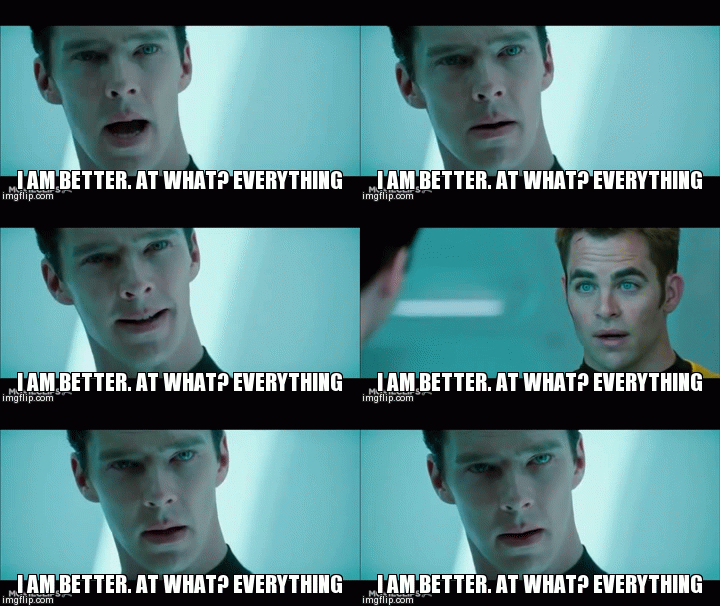
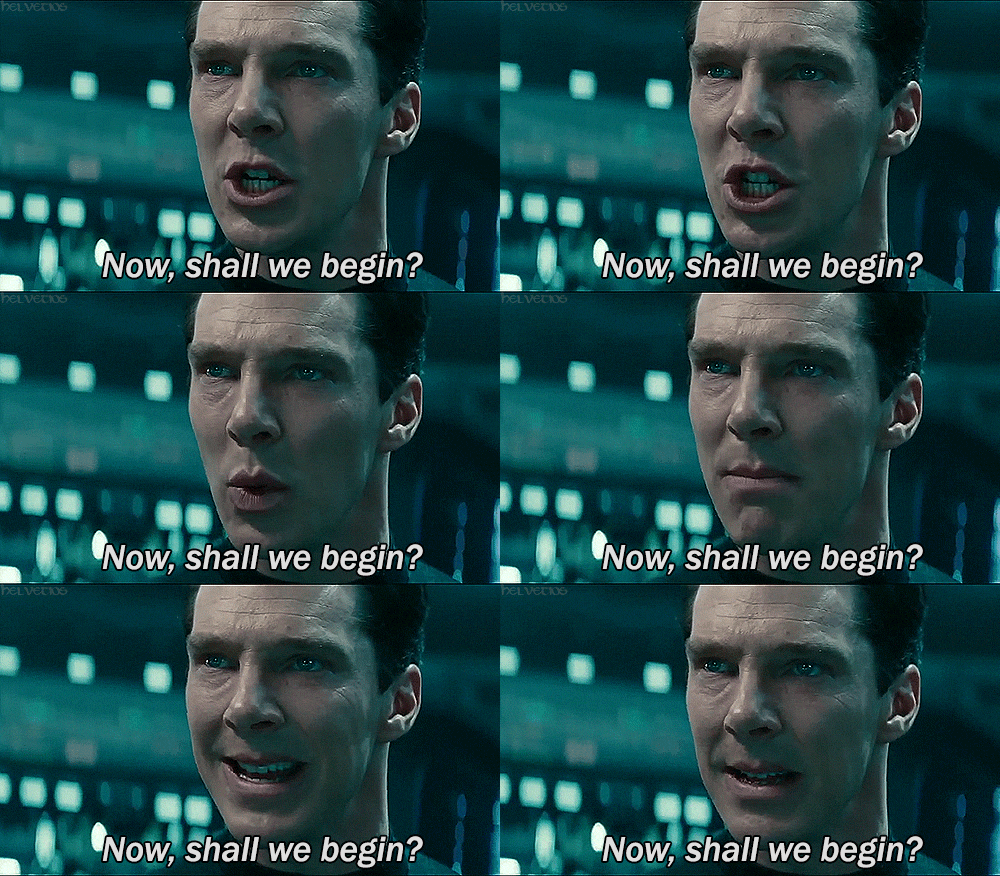
8. Khan from Star Trek: Into Darkness.
He really was.
Aside from the fact that he's played by Benedict Cumberbatch, Khan is amazing because one, he's a legit genius; two, he's sassy; and three, he's loyal. Yeah, he wasn't loyal to everyone - he totally back stabbed Kirk - but the amount of devotion he showed to his crew was so touching ("Is there anything you would not do for your family?"). Plus his plan-laying masterminding was so epic I can't even describe how much I love it.

7. Anakin Skywalker/Darth Vader from the Star Wars universe
Nevermind the fact that this is the fourth villain in a row. Anakin is sassy in The Clone Wars and Episode III just about killed me. I always spend the entire time screaming at Anakin from my couch, dumbly hoping that the outcome will somehow change. When he is evil he's sort of awesomely powerful and intimidating. but he's redeemed in the end. George Lucas did such a good job crafting Anakin's tragedy that it broke my heart.
Yes, except I'm pretty sure even I am a better actress than she was in that scene.
Plus, his name is an anagram of mine (I've had two people actually call me Anakin for a total of three times) which is awesome! I'm practically named after this guy!

6. Ender Wiggin from Ender's Game.
Cool, calm and controlled genius.
Just like most, I assume, I really love Ender from the book more than I love him from the movie. However, Asa Butterfield still did a good job of showing off Ender's character - the genius and the heart. I relate to him a lot, even if I'm not a child general.

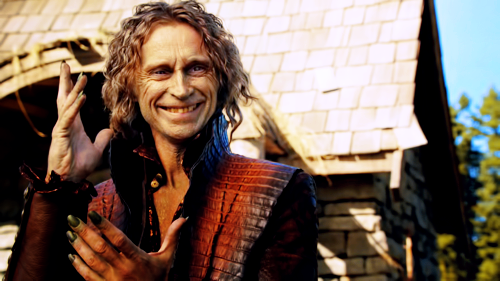
5. Rumpelstiltskin/Mr. Gold from Once Upon a Time. 
The Rumple = "Meeah heh heh! Magic always comes with a price, dearie!"
Isn't that guy's name a headache to spell! I don't like him as much as I used to but I still admire just how intricate (and generally successful!) his plans are. He is the epitome of evil genius. Seriously:


I applaud his schemes. If only I had scheming abilities on Rumpelstiltskin's level.

4. Sherlock Homes from BBC's Sherlock.
"High-functioning sociopath. With your number."
Who doesn't love him? Yes, he's an insensitive jerk a lot of the time but he's got a heart (actually, despite his line he isn't really a sociopath, which is actually the same as a psychopath, so sorry to bust the myth). Plus the way he can tell someone's entire history is . . . well, I so want that skill. I can have dreams.

3. Frank William Abagnale, Jr. from Catch Me If You Can.
This guy was so smooth. I'm impressed. He passed himself off as a pilot, a doctor, and a lawyer all before his nineteenth birthday and had gained so much money from his scams and forgeries and cons that I can't even remember the number. His ingenuity, intelligence, and ability to talk his way out of anything (I suspect ENTP) earned my admiration. He even escaped the FBI by pretending to be from some other governmental investigation organization, without any sort of badge. And he was a real guy. Yeah. Epicness. (As a side note, he ended up working with the FBI so I don't count him in as another villain on this list).

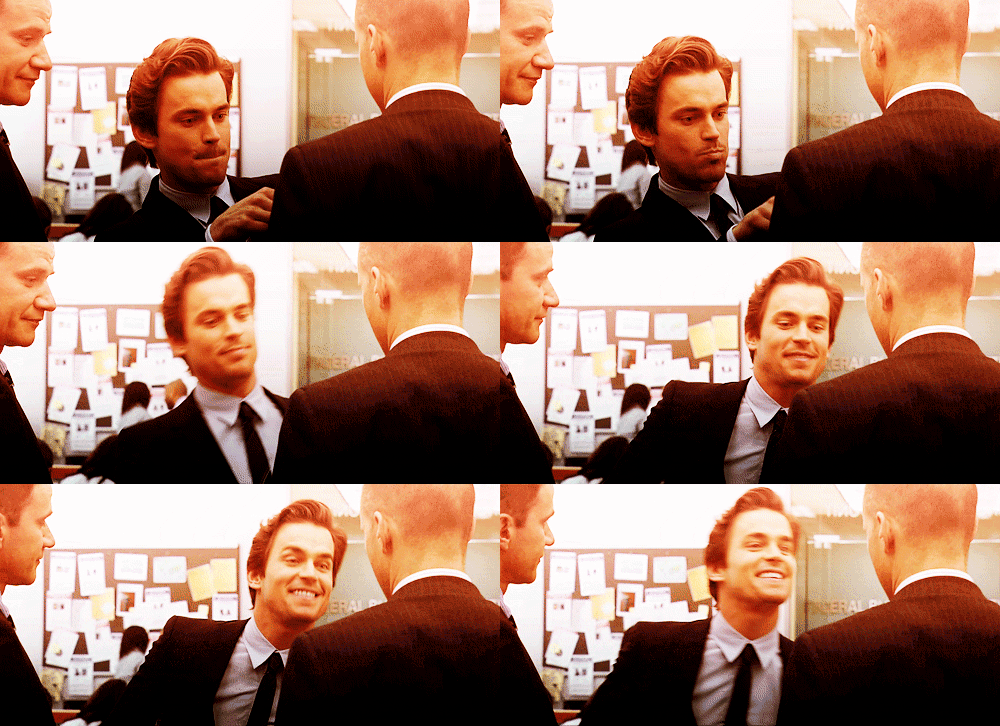
2. Neal Caffrey from White Collar.
"Boop!"
Another conman. What can I say, smooth-talkers impress me with their talking skills. Plus Neal is such a child most of the time. It's adorable. And the loyalty Neal shows Peter even though Peter is the one who caught him is so lovable. Gosh, I just love everything about this character and I haven't even finished season 1! Oh, and . . .
His hats.

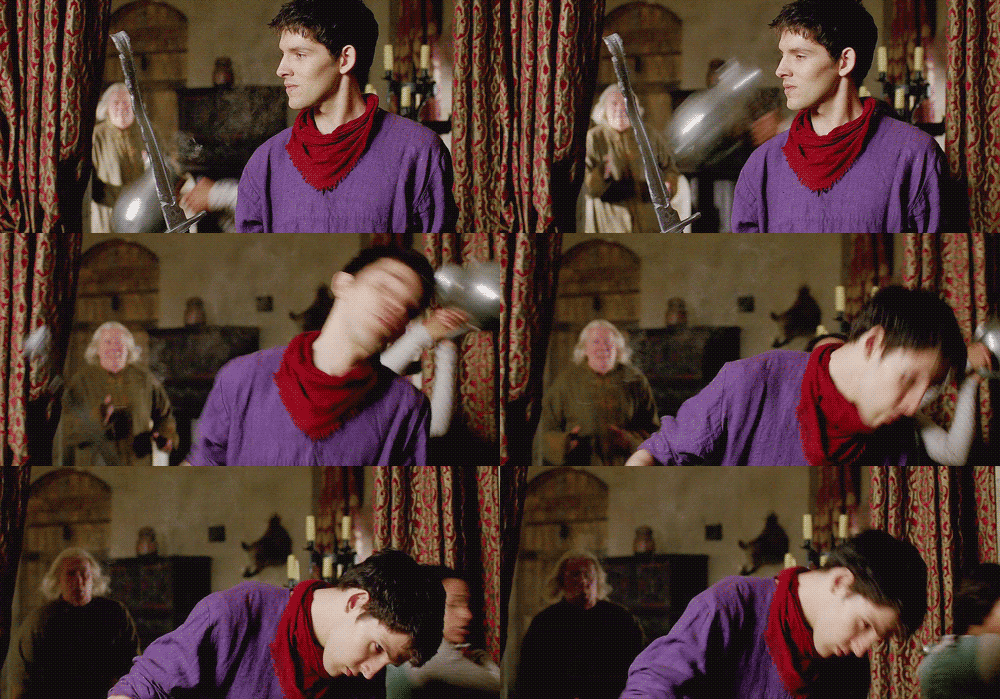
1. Merlin from BBC's Merlin.
Poor guy.
He's actually contesting with Neal right now, but I know Merlin better so he got #1. Merlin is sort of the oddball on this list of villains, geniuses, and con-men because there isn't really a bad bone in his body. He doesn't lay intricate plans, he's a terrible liar, he's an unrecognized hero. And he's adorkable.  I could spend hours just quoting all the funny dialogues between him and Arthur. Plus the sass levels . . . no one can compete. He sasses the king, for goodness's sake! (And Arthur likes him enough to keep him around anyway).

That's my list. I wish I had room for more gifs . . . now that I've used them, I like them. I also wish I could just write a entire post filled with Merlin quotes, but you can all just take a visit over to Pinterest for that. 
So, what can you learn from your favorite characters? What traits do they all (or most of them) share? Think of this as a writing exercise and make a list of the traits which make good characters. By spotting it in the characters you watch and read you can be more conscious of putting it into your own.
I'm going to go with Aimee's example and not tag anyone in specific. Open invitation, everyone. I had fun doing this and you probably will have fun too. Warning, it may be difficult to figure out which characters make the list and which don't. 
 If you do this, leave a link in the comments. I'd love to take a look at other people's preferences in characters.